Monday, June 9, 2014

[GUEST POST] Three Simple Steps for Men to Engage Resistant Men in Feminist Dialogue


Greetings!

I know, I know... I wrote another guest post.

I haven't published a piece for my personal blog in a few weeks, but it's been nice contributing to a few other blogs lately! I love sharing my voice and hope it allows for others to come forward with theirs as well.

I was asked by the #SAFeminist folks at the Student Affairs Feminist blog to write a post from the male perspective, so I did!

I decided to discuss how men can discuss feminism with resistant men. I've already received a lot of great feedback from this post and I am so glad it is helping further this very important dialogue.

Click the photo to access the FULL article!

Here are a few previews for you!
"Feminism is an interesting topic in the masculinities realm because I have found that some men are quite resistant to identify as a feminist.
Feminism—simply put—is advocating for gender equity. For all.
And men—simply put—are not good at sharing. At all."

"Men will always have privilege. Men do not need to apologize or feel guilty for their privilege—however, what we do with this privilege is what determines the future of our culture. So, in order to complete this step, make that point clear to men." 

"[in] order for true gender equity to occur, men need to learn to just step aside and be comfortable with women—and anyone who doesn’t identify as cis-male—being bad asses."

"Gender equity isn’t about losing your man card. It’s about recognizing that we all should be considered equal in this country, regardless of gender."

I will be back later in the week with PART ONE of a TWO-PART blog post collaboration with my #SABestie, Katy Hamm, on the healing power of music.

Be prepared!
Be well.

-Craig.

Sunday, June 1, 2014

[GUEST POST] 10 ways to survive your first year of #SAGrad

I have started blogging for the Student Affairs collective!

This collective is amass with some of the brightest minds in Student Affairs and I am eager to continue writing with and for them!

My first article was posted last week and I have loved the response it has received.
Just giving some of my tips on how to survive the first year of #SAGrad!

Here are a few snippets of the piece:

"4. Be a Devil’s Advocate.
Diversity of thought is important both in work and in the classroom setting with your cohort. Ask questions. Ask for clarifications. Be curious. You don’t need to agree with everything everyone says. That’s totally okay. An essential part of the learning process is seeing the other side of the coin.

Being constructive with your learning begins with being comfortable enough to question. I feel some of the biggest learning moments this year came when people in my cohort challenged each other. We never took things personally because we understand that we are all here to learn. Challenging each other is necessary for growth."


"9. GET OUT!
Getting your work done is important.
Getting some fresh air is also important. So get out!
This doesn’t only apply to going outside—which you obviously should do—but go on adventures. Concerts, hikes, sporting events—anything! Even if for only a day or night.
Explore—this especially applies to anyone going to grad school away from their home.
Leave your campus and be active.
Sometimes you need to just get your mind off your work and enjoy yourself for a few hours!"

Click here for the rest of the piece!

I will be back this week with a brand new blog post!

Be well!

-Craig

Thursday, May 15, 2014

MAKE TOTAL DESTROY

My #SACommits Confessional


[Note: Some language, suicidal ideation, real talk. Also, there is obviously much more to this story, and I hope to write more companion pieces stemming from this post, so please stay tuned!]


Being an extrovert can be a lose-lose personality type.

People often look for you to be the source of energy in a room.
You're expected to be upbeat and bubbly all the time.
But sometimes life happens...

Essentially, when I am too loud, people get annoyed.
And when I’m too quiet, people get worried.

Yet, as an extrovert there are advantages and disadvantages.

Advantages: Outgoing, energetic, positivity, people skills, self- confidence.
Disadvantages: Obnoxious, annoying, selfish, perceived unintelligent, over-commitment.
(Note: These do not apply to all extroverts, obviously.)

I am all of the above.

Me during high school.
I may never grow up.
First, a story of my youth—

In being such a young energetic (ADHD) kid—with hardly a language filter—I alienated myself from a lot of people and said a lot of things to a lot of people I should have never said. I was, and still am, a polarizing person. I recognize that.

And especially while growing up, I didn’t really know how to harness my energy constructively.

So I destroyed things. I smashed windows with rocks, kicked through walls, started fires constantly, and hit golf balls with a baseball bat into traffic. Those are things that I actually did.

And when I ran out of things to destroy, I would turn to myself.
My anger derived from feeling as though no one could relate to what was going on in my head.
And no one reached out to help me.

Counselors told me I needed to “calm down.”
Teachers told me to sit in the hallway so I wouldn’t disrupt the learning of others.
My parents told me I needed to “quit acting out.”

I often made a scene during class because I WANTED HELP!
But I didn’t know how to ask for it.

Instead of asking if I needed help, teachers just sent me to the principal’s office.
Effective.

I was aware that my obnoxious nature alienated me from many potential peer groups and honestly led to many people thinking I was very immature and idiotic. And that affected me. I genuinely had no idea how to help myself, and I didn’t know how to ask the few close friends I had for help.

This led to me developing a lot of issues with depression.
I felt alone. I would come home, crawl into bed, and cry in my room.
And the destruction issues I had regarding things evolved into harming myself.

Sometimes I just need to let it out.
[Photo: Katy Weaver]
I have attempted suicide twice in my life—the scars of one attempt are now covered with tattoos.

I honestly do not wish to return to those memories, so the exact circumstances will not be referenced, but I need to get that out of the way immediately.

Throughout high school and the early years of college, I harmed myself in various ways of which I hid. Much of this harm was due to multiple aspects of my mind fighting against me.

A lot of this harm was due to my consistent failures with relationships—of which I had little faith until about two years ago.

As I said before, a disadvantage to being an extrovert is that some of us are pretty selfish people. I am selfish. I acknowledge this. And I’ve learned a lot since getting older, but I surely was a terrible person to date because I like being independent. And I also like being selfish. And I feared compromise. However, I also wanted companionship. And I wanted to care for someone. And I didn’t want to be alone. But I do not deal with rejection well.

However, all of this cognitive dissonance led to me having no idea how to support someone else when I couldn’t even handle my own shit. I also overthink everything—if you couldn’t tell.

And when I felt things falling apart I would try to drastically solve all of the problems all at once to fix the relationship. And I always failed. I failed constantly. I would use guilt to manipulate whomever I was with because I didn’t know what else to do. And it was impossible to gain any sort of self confidence in relationships because I knew I would destroy them eventually.

And then I would turn on myself.

Probably the strangest thing about being an extrovert is that I was able to hide a lot of my pain, frustration, and anxiety by forcing myself to be myself—an overly enthusiastic, life of the party, energetic, lover of life. You know, like an extrovert.

But I haven’t always loved life.
I have always had to hide.

I always come back to this image. It's too true.
Writing has always been my most effective way of working through a lot of my depression and anxiety throughout high school and college.

I don’t have to hide when I write.

And if you haven’t noticed, I write a lot.

I have kept journals for as long as I can remember.
I wrote for myself and it was the best sort of therapy.

Many of my notebooks and journals are no more.
I often destroy them once they fill up because the simple act of having written out my words is enough for me.
I have no need to keep those words.

However, since I love words and I love writing, I decided to become an English major, which was the best and worst thing to happen to me.

I kept journaling through college, but it took a different shape.
I would compete with my classmates in a way that was unnecessary. I wanted to impress my professors. I wanted to challenge my classmates by writing about REAL LIFE. And honestly, I think some of the tactics I tried were doing more harm than good for my credibility as a writer. I mean, I thought I was a good writer.

And it only led to great amounts of anxiety.

Why the fuck am I not getting As on these stories?
How did they get a better grade on this paper than me?
I poured my heart into this story!
I thought I was a good writer.
How do they write more vividly?!
What do I need to write to impress you?!

These thoughts would race through my head whenever I received a grade on a paper or a story.
I knew I was a good writer, but I wasn’t seeing the results.
I thought I was a good writer.
I felt as though I was failing at being a writer, just as I was failing at relationships at the same time and writing about those failed relationships as a form of therapy.

It became a vicious cycle.
I thought I was a good writer.
But I kept feeling I wasn’t good enough.

I would go days without eating—obsessing over being a better writer.
When I didn’t eat, I couldn’t sleep, and when I couldn’t sleep, I would obsess over how it was impossible for me to ever reach the level of my classmates, and I certainly wouldn’t reach the level of the writers I admired. After all, I thought I was a good writer.

It was vicious cycle on top of vicious cycle.
I thought I was a good writer.
But I kept feeling I wasn’t good enough.

This unnecessary competition that only happened in my head went on for at least three years.
It made me a mess of feelings and anxiety.

I THOUGHT I WAS A GOOD WRITER.

There are many reasons I didn’t continue pursuing writing as a career.

My anxiety toward a life full of failure and rejection was a major factor.
It also had to do with another element—alcohol.

I used to drink constantly when I wrote.

From a photo shoot for my first EP last May.
It was a transformational experience.
[Photo: Luke Wenker.]
Now, for starters, I didn’t drink alcohol until I was 21.
That’s right. I waited.
And when I started drinking, I HATED IT!

However, it just so happened that my 21st birthday and ending a nearly two-year relationship closely coincided. So I developed a taste for beer quickly as I found that it helped me repress the feelings I still very much had for the partner who left me.

My second suicide attempt actually occurred shortly after that relationship ended. And my motivations were purely fueled by alcohol. I felt like a failure again. I was so sure that this relationship was it for me, but I was wrong. My trust and faith in relationships was destroyed. I had no idea how to process this pain, so I drank. And I was so new to drinking that I didn’t know my limits, so I wound up making a poor decision while under the influence of alcohol.

I never thought of myself as having a problem in comparison to how much I saw others drink—but the point of this is not comparison. While I may not have had issues with drinking to excess, I personally struggled with the reasons for why I was drinking to begin with.

I drank to not feel pain.
I drank to fall asleep at night when my mind kept me awake.
I drank to ignore my depression—to lessen my anxiety about writing, about life, about relationships.

I was actually an RA at this time. And I was pretty good at hiding my depression around my residents because I ignore whatever issues I was dealing with in order to help them with their issues. And that only made things worse for me. I was taking in a lot of emotions and not letting any of mine out constructively. Except through drinking.

And of course I didn’t want anyone to think of it as an actual issue, so I’d often sneak alcohol into my room—like my underage residents would do. I was ashamed. I didn’t want to admit to anyone that I was struggling with a hidden drinking problem.

The issue only perpetuated further when I was teaching high school English. I would read so many stories of students struggling with the realities of their own lives, which made it more difficult for me to process my own life. So I drank. Every night I would come home, decompress, drink, grade, drink, and sleep.

I wasn’t happy. I wasn't healthy. I wasn't me.
I felt I was destroying myself.

I struggled to go in to teach every day because I felt as though I couldn’t actually connect with my students because I was losing track of who I was as a person.

The interesting thing is that during all of this, when I would talk to friends about drinking, many of them would say, “Oh, but you hardly drink—”

And in my head, I would reply, “Yeah, that you know of.”
Even if I tried to explain the extent to which drinking was a private activity for me, I know that many of my friends would have never understood. 

So I kept it hidden.

Sometimes life is dirty.
[Photo: Luke Wenker.]
After a few years of what turned out to be meaningless “romantic relationships” that ultimately destroyed trust in myself and relationships in general—for various reasons, many of which are my fault. I own that. Alas, while I was being reckless with my body, I recognized that I didn’t like who I was becoming, so I reached out for help for the first time in my life by going to Oregon State University’s Counseling and Psychological Services.

I maintained going to counseling while I was an RA, stopped for a few months, and then continued during my student body presidency, and concluded counseling through being a high school teacher.

Counseling really helped me put a lot of things into perspective. And it helped me conceptualize a lot of my feelings within the larger social constructs that have led to my inability to properly communicate all of the thoughts, fears, frustrations, and denials going on inside my head. I needed to be able to share these thoughts and have someone help me process.

In many ways, I am who I am today because I asked for help.

Being able to talk with someone about my issues and process my depression and anxiety was incredibly necessary for me. I was able to develop better self-control, a better sense of self, and a better sense of identity.

As of today I am over 22 months sober and I have no intent to pick up a drink again. I don’t like who I am when I drink and I certainly do not like the feeling of being out of control of my body or my decision making.

And as I reflect on so many past experiences, there are a few things to take away from this post:

- Sure, extroverts may appear to be fine on the outside.
But that does not mean they are fine on the inside.

- As I’ve grown older, I’ve learned how to ask for help.
It takes time for most people. And it is always okay to ask for help.

- Many depression and suicide attempts during college stem from relationships ending.
Being able to acknowledge these situations as valid struggles for our students is important.

- Students want help and we need to know how to acknowledge signs and ideations before they turn into larger issues. Because I have struggled in so many ways with depression and anxiety, I know firsthand the realities of feeling like no one is there for you—like you are alone.

- No one should ever feel alone.

In many ways, I am who I am today because I asked for help.

I was recently talking on the phone to my mother and twice she said, “I feel like I’ve failed you, son.” To which, I replied, “No, mom—society has failed me.”

Society has failed all men.
Men should not be afraid to come forward with their emotions.
I didn’t want to talk to anyone—even though I needed to do so.

Ultimately, my reason in sharing such detailed information about my experiences with depression and anxiety is simply that men do not want to talk about this. And the only way I was able to get help was by reaching out to a specialist.

Men cannot hide their mental health issues any longer.

We MUST create brave space for men to feel comfortable to share the reality of what it is like to deal with mental health issues. Otherwise men will continue to repress their feelings & will perpetuate the statistics proving that four times as many men commit suicide than women.

This is our chance to create change and create a brave and caring community in which men are comfortable with their emotions to open up. Otherwise, men will continue to feel as though they won't be taken seriously when coming forward with ACTUAL issues.

Never tell a man they are being dramatic when they bring up issues regarding mental health. THAT is the harmful stigma at play that makes it nearly impossible for men to share in the first place. This takes reaching out to young men early in their schooling and not trying to lump children into these useless boxes of ADHD just because teachers are too lazy to actually sit down and talk with a student.

I wanted help when I was growing up but no one knew how or was willing to help me.

Society has failed men long enough. It is time to turn the tables and show men that it is important to ask for help. Our culture must eliminate stigma that men who share their emotions are weak or feminine.

Mental illness stigma harms everyone.

To the friends who may know these stories and were there to support me, I thank you. Your care means the world to me. I know I am not alone anymore.

I hope this post resonates in some way.
Be well.

-Craig.

PS: Hi Tat.

Thursday, April 17, 2014

No Co-Sign Necessary

Do & Enjoy What You Love—Because You Can


The cool thing about being a person is you can choose how you spend your free time.

That might be one of the simplest statements I will ever write; and yet, it’s so incredibly true. I can even follow it up with another bit of simplicity—a question:

For those in the higher ed/SA realm—how do we maintain the aspects of our lives that we are passionate about outside of higher education and student affairs?

For those outside of the SA-realm—1. Welcome to the conversation; 2. How do you manage your interests and passions outside of your industry?

For some people maintaining health and fitness is an essential passion to maintain; for others: sports, reading, writing, knitting, Snap Chat, painting, performing and/or listening music, concertgoing, hiking, cooking, tattoos, computers, tech—the list goes on. Some of these are somewhat easily integrated into our lives; however, some may be more difficult than others.

So how do we maintain the balance of doing what we love in our careers and doing what we love in our extracurricular interests?

How do we integrate balance in the first place?

I often hear people say, "I love reading, but I just don't have time anymore."
Or, "I wish I had time to paint more."

Hearing things like this makes me sad.
How do we avoid sacrificing our passions when life gets busy?

My suggestion: Make your passions a priority.

Cody Rhodes (right) delivering his finishing move, Cross Rhodes.
He is one of my favorite young talents.
My most implicit example of this is with my love for professional wrestling.
Yes, professional wrestling.

For me, Monday nights have three hours carved out so that I can watch Monday Night Raw. And during the rest of the week, I most certainly squeeze in any opportunity to view a match or two on the WWE Network or across any of the independent circuits that I can scout out on Youtube. I am eager to learn new stories and in-ring techniques being experimented with throughout the professional wrestling industry—so I try to keep on all levels of competition outside of simply WWE.

People often bash/laugh at my appreciation for professional wrestling. And I get that. Pro wrestling (or, rasslin) isn't for some people. It isn’t for most people. But to laugh and use the defense of, "but how can you watch that stuff? ...it isn't real ...it's scripted," makes no sense to me because everything is scripted.

Archer is scripted.
Scandal is scripted.
Mad Men is scripted.
Bob's Burgers is scripted.
Duck Dynasty is scripted.
Captain America is scripted.
Game of Thrones is scripted.
Books and music are technically scripted/written.

Just because something is scripted doesn't mean it doesn't hold value.
Enjoy what you will. Enjoy what you love.

Also, scoffing at something that someone gets enjoyment from is outright disrespectful. Now, I am guilty of laughing at some interests when I am caught off guard—much like most people are when they hear about my passion for rasslin. However, I am always curious to learn why someone appreciates a certain hobby/interest. The quirkiest hobbies always have the best stories/reasons.

John Cena (left) and Bray Wyatt (right) put on one of the most
psychological matches in recent memory. 
Last week I spent three days (WWE Hall of Fame, Wrestlemania, and Monday's epic RAW) being reminded of how much I respect the industry of professional wrestling. And I felt the need to reflect on my passion for this industry. Because when rasslin is good, it fills me with legitimate joy. And there is truly no better feeling than when you see dudes who have dedicated their lives to this industry and hear their stories and see their hard work pay off.

I've loved professional wrestling since I was a child and I continue to love it to this day (minus a few in-between years). I may watch rasslin from a much different lens, especially since entering graduate school. But I still look forward to it every week and just because I may not agree with the script all of the time, I still appreciate the art.

And when I don't agree, I make podcast episodes with my friends to complain and discuss pro wrestling! I love recording these podcast episodes because I get to prioritize and schedule 1-2 hours out of my week to just talk about rasslin. To just talk about something I love outside of higher education. It is truly a lot of fun for Ian, Rene, and Me (other dudes in the Against the Ropes podcast—Warning: Not all language is SFW.).

I actually hope to pursue a PhD in sociology or American studies focusing on the performative aspects of masculinity in professional wrestling and its effects on children. I genuinely think about rasslin a lot and want to enter into dialogue with this topic at a level of scholarship that hasn’t been touched yet.

Many people hold an image of rasslin from years ago when it was a much different product than it is today. Things have changed. The independent scene is stronger than ever and the big companies have taken note. This is why I appreciate professional wrestling. It is always evolving.

[NOTE: I originally wrote the previous text on pro wrestling, with some new edits, as a Facebook post fresh off my high from the incredible spectacle that was Wrestlemania 30.

And then Ultimate Warrior died. So I wrote the following…]

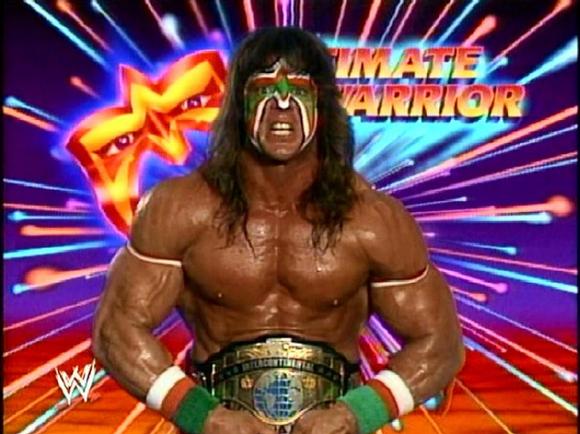
Ultimate Warrior was a staple of the WWF in the late 80s/early 90s.
My heart literally stopped when I read that Ultimate Warrior (given name: James Hellwig) died last Tuesday. This was literally the day after giving a highly motivational and coherent speech on Monday Night Raw—fresh off his induction into the WWE Hall of Fame that Saturday, and appearing at Wrestlemania on Sunday. I waited to write anything about his death until I knew exactly the full extent of the circumstances.

Heart attack brought on by stress. Makes sense.

Warrior lived fast and he lived hard. And since leaving rasslin, he has certainly left the limelight and withdrew from the public eye. Which, when he begins being moved around a lot over the span of a few days during Wrestlemania weekend—and possibly the hazardous cocktail of 90s cocaine/steroids may have caught up to him—his body might not have been able to handle the stress.

This early death is tragic and all-too-common in the industry of professional wrestling—Curt Hennig, The Von Erichs, Bruiser Brody, Gorgeous George, Eddie Guerrero, Owen Hart, Test, Big Bossman, Randy Savage, Chris Benoit—again, the list goes on.

I’ve been reading David Shoemaker’s book, The Squared Circle: Life and Death of Professional Wrestling, which chronicles the lives and history of many professional wrestlers who have legitimately given their lives to this industry. The book reads as one long cautionary tale for today’s rasslers to take note of the lives that have been led and lost throughout the history of this industry.

Many rasslers take extensive breaks (sabbaticals) to rest up and heal so that they don’t go down this route. The industry has changed drastically, as I alluded to earlier. Steroid usage has visibly lessened as rasslers have gotten smaller and leaner in comparison to the bodybuilding behemoths on the 80s and 90s. Wellness policies and health insurance are staples of the industry now.

When you are so engrained with characters in a book or in a TV show or in a movie and they die or are killed off, you feel like you’ve lost a bit of yourself. When Ultimate Warrior died, the world of professional wrestling lost a superhero. We lost a character that was larger than life. We lost not only one of the most iconic members of our community, but we also lost a man who inspired many young men to break into this industry. Warrior set the bar as a physical specimen and as a dominant force on the microphone.

I mean—watch this video:


Ultimately, I want to bring this back to my earlier context of being true to yourself and to what you enjoy doing with your free time. Rasslin was merely one example I could've used for this article. I also appreciate music, television, reading, writing, running, etc. The point of this post is the demonstrate that we only get so much time away from work and from the realities of life—so we might as well spend those spare moment enjoying things we are passionate about.

Don't lose an aspect of your identity just because you get a little busy from time to time.

Also, don’t worry about what people think about your hobbies.
Everyone is different.
Different strokes for different folks. Everyone has their quirks.

There are many reasons you enjoy what you love in your life—some may have different origins than others and may look differently in comparison with other people in our field, and that’s fine. Life is about filling your life with things that make you happy. Sure, work and making a living is important, too, but that doesn’t mean we must sacrifice our interests

Do and enjoy what you love not because the media or your friends tell you that you should love it. Do and enjoy what you love because you genuinely cannot consider anything else you'd rather spend your time/life enjoying. It really is that simply. No co-sign necessary.

Stay true to yourself—be proud of your interests.
Don’t hide them. Don’t be ashamed of your quirkiness.
Be quirky. Be a hobbyist.

Hope some of this resonates!

Be well.

-Craig.


Join the dialogue: @CrigBididman

Thursday, March 27, 2014

Keep Snapping

Authentically Surviving a National Professional Conference


Beware. This is a massive post with a lot of feels.

*          *          *

My goal in attending the over 5,000-attendee national Student Affairs Administrators in Higher Educaiton (NASPA) conference in Baltimore, Maryland was to attend as an authentic student leader. My goal was not to get a job—like many of those attending for the Placement Exchange. My goal was not to gain a million Twitter followers. My goal was not to be anything I wasn’t. My goal was not to hide.

I wanted to be myself—that phrase we always tell our students to embrace.
And myself can be a bit much sometimes, and I recognize that.
Those who met me at NASPA quickly learned this.

So, I packed my bag—some flannel, some T-shirts, a vest, a cardigan, two dress shirts, a bow-tie, slacks, jeans and two pairs of shoes—I also packed food and some work out gear, but hardly had time for either.

And honestly, the dress shirts and bow-tie never saw the conference because I wasn’t feeling it. I brought them in case I felt the urge to have some fun with dress up time; yet, the time never came. I wanted to be comfortable throughout the conference experience and dressing up to fit in with the rest of the frame felt too forced to me. So I didn’t do it—

[Note: I’ll get to my reasoning later in a conclusion I originally wrote to be the intro to this piece, but felt it landed better as an ending. You can totally skip to it right now by going to the next section starting with a bold italic note and I wouldn’t even be offended or surprised. Sort of like a choose your own adventure! I write too much sometimes—this post being one of those times.]

Opening night of NASPA with Bethany and Jack!
(Picture stolen from Jack)
After the six-hour drive to Baltimore with my two cohort colleagues, Nadia and Ashrita, we found our hotel, unloaded our things—I took a quick nap—and then we made our way to the conference. Upon arrival, I sought out some Twitter folks, Bethany Tuller (@BethanyTuller) and Jack Korpob (@JackKorpob), because I knew they were there and I knew this conference was going to happen because of Twitter. It was great to finally meet them and discuss our lives as fellow #SAGrad.

This was the first national conference I’ve attended since what I’ve considered the mass influx of Twitter in Student Affairs over the past two years. So, to me, NASPA meant putting a lot of Twitter handles to faces! And that’s exactly what happened. I ran into so many incredible people that I’ve interacted with throughout the last two years or so and finally got to meet them face to face. It was truly inspiring to see how well Social Media functioned in making introductions easier for us at NASPA.

Josie and I posing with the #SAChat pillow!
We had #SAChat tweet ups, which were great to meet so many more folks that I’ve known virtually and could now know personally—mystical creatures like Lisa Endersby (@LMEndersby), Joe Sabado (@JoeSabado), James Frier (@JSFrier), Joe Ginese (@JoeGinese), Mairead KIernan (@Parade_withan_M), Amma Marfo (@AmmaMarfo), Matthew McGrath (@MMcGrath528) and the wonderful, Josie Ahlquist (@JosieAhlquist). Josie and I even got to offer folks the opportunity to take pictures with the #SAChat pillow! It was a wonderful opportunity to finally have human interactions with people who actually do exist and truly hold great insights and feelings toward this field. And the coolest part of the Twitter aspect of #NASPA14 is that we trended!! It was obvious once we started getting hackers…

Combatting those Twitter hackers/spammers by blocking and reporting spam became part of my role as I supported the Innovation Lab at NASPA for both Monday and Tuesday. The Innovation Lab was a great opportunity to teach and learn about how technology and social media play a massive role in our work at higher education and student affairs professionals. I helped people learn more about many aspects of social media and even signed a few folks up for their own very first Twitter accounts—including the chair of the NASPA conference, Frank Lamas (@LamasVPSA)!

Helping out at the Innovation Lab!
This opportunity allowed me to socialize and discuss with many student affairs folks and fellow #SAGrads about how we can integrate a more functioning and informed community through the advancements in technology and social media.

I was also able to represent the new NASPA Knowledge Community on Socioeconomic and Class Issues in Higher Education, which merely days old when NASPA began. So this was our first opportunity to reach out to institutions to share the vision we all have for bringing this KC into collaboration with all other KCs in hopes of truly demonstrating how many of the issues our students face are transferable through these issues of SES and class.

My attire on Day 02 of NASPA, when the tattoo article published.
Something unique about my stay at NASPA was that I contributed an article to the ACPA Men and Masculinities blog that published on the Monday of NASPA. The article focuses on tattoos in higher education. A day after the article published and was circulating around the interwebs, people were coming up to me at the conference to talk to me about the article and to talk about my tattoos—which were unhidden throughout the most of the conference. This was a great form of validation for my writing and for my pursuit to live and function as an authentic leader.

This was such a bizarre feeling because I came to NASPA with specific people that I wanted to make sure I either met for the first time, or got to connect with from my past. Getting to connect with my former mentors from Oregon State University, Mamta Accapadi (@MamtaAccapadi) and Larry Roper (@LarryRoper), was incredible—while both were in passing, they each imparted quick bits of knowledge upon me that made everything worth it.

Getting to meet up with Larry Roper (L) and
Chris Van Drimmelen (R) was much needed.
I also got to reconnect many times with my good friend, Chris Van Drimmelen (@CVanDrimmelen), who is finishing up his #SAGrad right now at Seattle University. He and I spent much time together during our undergrad at Oregon State and it was great to share ideas about higher education and reflect on how our lives have changed since running student government during our undergrad. We’re getting old.

Meeting up with the multi-talented jet-setting blogosphere champion, Eric Stoller (@EricStoller), was also quite the treat. Hearing him reflect on his perspectives of technology in higher education as well as how we must challenge the frame to make any true change in this field really resonated with me. He also spent much time at Oregon State, so it was great to discuss life in the Pacific Northwest with someone as perceptive as he—someone so perceptive that he pointed out the exclamation point at the end of my name on my nametag in the middle of his presentation session.

This exclamation point came up again during my opportunity to meet my future employers for the summer as I head back to the Baltimore area to work at Towson University. I met my future supervisors from Towson, one of which commented on my exclamation point—to which I said, “Well, I’m like a human exclamation point!” To which she responded, “That’s great—because you’ll be working with many human exclamation points!” It made me feel very comforted that I will have a welcoming community of professionals to work with for a few months.

Of course there were sessions that I attended! I learned a lot about how to challenge and approach best practices when supporting/creating an organization. I learned a lot about how to support college men through meaningful dialogue during a very lively discussion. I learned about how to support a campus that suffers from repeated sexual assault.

I attended Wes Moore’s opening keynote that started the conference off with a bang with his plea for us to engage our students in more than just their educational experience during college and to support them in extracurriculars. This sentiment also resonated with professional staff as Moore pontificated that, “when it’s time to leave here…make sure that it mattered that you were ever even here.”

Moore’s keynote was a breath of fresh air. And then I reached the closing ceremony and encountered Jon Lovett’s closing keynote speech. Lovett, President Obama’s formerspeech writer, is a hilarious man with a lot of knowledge. He spoke from a podium in a hoodie—I, too, was wearing a hoodie that day. In solidarity, of course. Lovett is a young man with a vision of authenticity that resonated with me unlike anything I’d ever heard. Among other brilliant words he spoke, Lovett called for a “renaissance of integrity” in which those of us in leadership/administrative roles can influence the pivotal college years of young people and inspire them to do great things by simply staying true to ourselves as role models.

Jon Lovett: Pretty chill role model if you ask me.
And I was tweeting and snapping my fingers along with Lovett every step of the way. For those unaware, snapping is generally done when agreeing with what someone is saying, to encourage them and hopefully motivate them to continue exploring the roll they're on. My fingers couldn't snap fast enough for Lovett's speech. It was a blast to be fueled with such invigoration for change in this field. I had to share my support on the Twittersphere. It felt great to feel validated yet again by this keynote that was supporting every claim I’ve made throughout my time in student leadership and into being a higher education paraprofessional.

And then Lovett said he had time for one question.
So I walked to the mic.

I thanked him for saying what we all needed to hear and said that I had only one question to ask.
It was a simple question—can I shake your hand?

And he said of course, and shook my hand in front of everyone.

I wanted to shake his hand because he was preaching exactly the words I wanted to preach. He was expressing every frustration I’ve ever felt and everyone in the room was listening to it. I wanted to shake his hand because for the lesson of authenticity he shared, I felt I had been living it throughout this conference. I wanted to shake his hand because it was incredible to see someone so well-respected—someone who essentially helped our president get elected—get such a great response to what I was living out.

During this massive Twitter explosion spurred by my tenacity for everything Jon Lovett had to say, the NASPA folks contacted me on Twitter and informed the public that I was to be acknowledge for my Twitter participation through the conference. When I strolled into their office, I was greeted with loud snaps and excited cheers and they informed me that I had won a Best Tweeter award for consistently engaging people throughout the conference on Twitter—especially for my contributions to the conversation around Lovett’s closing speech. They even put me in the closing blog post for the event!

I told the staff this felt like one of the oddest forms of validation in our field, but I’ll take it! Given the work I put in with the Innovation Lab and through engaging folks online, I felt it was a great token of support in moving forward with this career. Especially since I felt I was validated while functioning as my 100% authentic self. As I left, the group told me to "Keep Snapping," something that will always stick with me.

It meant everything to me.

Me on the final day posing with the NASPA
staff after winning Best Tweeter
[Note: This is where you could have/should have/would have jumped forward if you wanted to avoid all that self-indulgent talk of my NASPA explorations.]

Much of my decision to avoid professional attire was two-fold. Firstly, the decision came on the heels of having to finish a paper while attending the conference, so I had that lingering over me; so, for as much as I wanted to feel like a paraprofessional at this conference—I was certainly attending as a student.

Secondly, my word of the year for 2014 is Risk.

So I wanted to take a risk and take this tiny decision—seemingly simple to me—something vastly beyond what anyone else did for this conference, and try it out. It was wonderfully embraced by those I came into contact with. People were open to discuss the true functionality of how supporting authenticity can operate even within student affairs professionals and budding professionals like myself.

Because if student affairs professionals are to support authenticity in our students, we are hypocrites if we don’t live it out ourselves.

Dressing up during that conference, to me, would have felt like I was lying to myself. I am not a professional. Yet. Even when I become one, that doesn't mean I am going to give in to the suits every day! I am still very much a student functioning in a role that serves other students. Sure, I am graduate student, but I don't see how that slight disconnect changes anything for me. I want to be approachable for my students and I want them to be comfortable with me. Some attire choices may send the message that I am above them and I do not want that. And is that the message we should send our students?—some of which who literally cannot afford "interview clothes"/"business clothes." Therefore, I cannot present myself as someone above what I truly am—a student. With this, I chose the shirts, the jeans, the flannel—I chose comfort over conformity.

And this isn’t bashing professional attire whatsoever—if you are comfortable wearing suits and ties all day, by all means. Do it. Do you. I honestly feel I “clean up well” when I feel comfortable enough to rock some slacks and a bow-tie one day and flannel with a beanie the next day. I can do it. I just don’t choose to do so every day. And shouldn't feel forced to do so, either.

I think I clean up well. Check out the bowtie!
So please don’t expect conformity from those who would not operate authentically, for example, in a suit. The judgment of whether someone cares/respects about a specific job or conference or interaction based on how they dress does not make sense to me—and is also a function of class oppression. I paid my own money to attend this conference. I purposely drove six hours to this conference. I obviously care. I have dedicated myself to this field. I wouldn’t attend if I didn’t care. I wouldn’t keep myself up at night obsessing over how to support my students better if I didn’t respect this field. But I don’t need to do all of that while wearing a tie or a freshly pressed shirt.

Mandating or simply expecting "appropriate"/business attire isn’t a sign of ultimate respect. "Appropriate"/business attire is the sign of conformity that functions as the byproduct of privilege and oppression—the control of the ruling class to keep the oppressed class in check by expecting them to dress a certain way to function and be successful in society.

Believe me, I recognize this discussion enters a realm of white male privilege that functions MUCH differently for me than it does across race, class, and gender lines—because this is an essential facet to acknowledge. But that’s for a future post I plan to write using some of this material and actual scholarly work to support my outlandish/anarchist views.

Consider this a call to arms in which I truly feel there truly needs to be an insurgence in the way we consider professional attire/business attire/business casual. This rethinking will benefit of our students and their authenticity, it will benefit of ourselves and our own authenticity, and it will benefit our field—which already stands as a community filled with the most unique and inspiring people in the world.

I drove six-and-a-half hours south to Baltimore to hang out with a bunch of student affairs professionals and all I got was validation, incredible learning experiences, and an awesome hoodie. So, you know, all in all, it was a great trip.

-Craig.

[ACPA GUEST POST] Skin Deep: On Being a Tattooed Man in Higher Education

Hi all!

I know I was absent from posting on my own blog last week. This was due in part to attending the NASPA Conference in Baltimore over spring break, and due to me having a guest blog post on the ACPA (American College Personnel Association) Men and Masculinities Blog.

I wrote a post titled, "Skin Deep: On Being a Tattooed Man in Higher Education."
And it kinda took off, so that was cool.

In fact, I will post the link to their page here:

http://acpascmm.blogspot.com/2014/03/skin-deep-on-being-tattooed-man-in.html


Make sure to also follow them on Twitter:
@ACPA_SCM


And to tease your intrigue, here are a few of my favorite quotes from the piece itself.

"Further, living in a society that already suppresses male emotions, tattoos can be an essential form of personal authenticity and expression. However, the long discourse has been that, in order to move up in the world, men must cover themselves in business attire to be taken seriously among other administrative men. This is unacceptable because forcing men—across race, class, and sexual orientation; including women—to dress a certain way to be accepted perpetuates systematic oppression of authenticity."


"Tattoos are therapy—representative of our past, our present, and future—and allow men to create tributes to our mothers, fathers, wives, children, struggles and/or successes in life, appreciation of music, art, and literature. If society and/or academia suppress men from expressing their emotions by literally wearing their heart on their sleeve, then where can men express ourselves fully authentically?"


"There is always a story.

Students engage in this story. Students are curious to learn the significance of each of my pieces. Students often ask how many tattoos I have—I truly have no idea anymore—so I respond with my hour/sit ratio. (Note: I’ve sat 20 times for 55 hours.) With these tattoos, I make connections with students. I am human to them. I am authentic to them because I am not hiding."


"I unapologetically identify with tattoo culture and I am proud to be a future student affairs professional. My only hope is that this will begin the conversation for institutions and supervisors to rethink how we think and view men with tattoos in higher education. There is already a great deal of change taking place in higher education and I see more acceptance of tattoos—which is great—but I will not feel tattoos are truly accepted until the day I no longer have to hear someone explain that they must strategically place a tattoo so it doesn't show at their work.

Get tattooed. Share your story."


Enjoy!!

And prepare for my next post on my NASPA experience!

-Craig.

Join me in dialogue:

Tuesday, March 4, 2014

This Band is so Gay!

A Lesson in Homophobia and Performative Masculinity in the Metal Music Scene


[TRIGGER WARNING: Homophobic language.]


I had to sign a waiver before I entered the venue.
That’s how I could tell this was going to be a great metal show.

Amid the musk of body odor and PBR, through the swaying bodies of beard, flannel, gauges, and tattooed fists, I found my way to the pole in the middle of the floor—there’s always a pole.  It supports me through most metal shows, which often take their toll on my body after a few bands.

I was nodding along to the opening act, giving them some credit for playing what appeared to be a hard to please Clifton Park, NY crowd. And boy was I right.

Between the Buried and Me was the headlining act.
I love those guys. They prove vegans can kick ass.
The crowd was overwhelmingly a BTBAM crowd. It seemed there was little room to be impressed.

Which brings me to right before BTBAM when deafheaven performed, which is the band I truly came to see, seeing as I'd been to a number of BTBAM shows in the past. Deafheaven released what I considered the most important metal album last year, Sunbather, on what I consider to be the most important record label today, Deathwish Records. The band combines beautiful atmospheric elements of Explosions in the Sky with the power and shear brutality of black metal.

However, their sound hasn’t been completely accepted among metal purists because it is too atmospheric and uplifting at times while the lyrics are screamed completely incoherently to the untrained ear.

I was in love with their opening number, “Dream House,” the first track on the aforementioned, Sunbather. The track has so many elements of dynamic emotion and raw, heinous, unbridled metal. After the euphoria of the nine-minute epic, I was given a chance to breathe.

That’s when I heard it.


George Clarke of deafheaven consistently brings a dynamic performance.
“This band is so gay!”

The man who said it resembled a young Rutherford B. Hayes—with one full sleeve of tattoos, a Bud Light, and an unkempt beard. I turned my head immediately and responded, “Not cool, bro.” He smirked at me and said some other unsavory words. The next song, my favorite song, started, so I turned my attention back to the stage.

Ten minutes passed as I enjoyed the next song—however, I couldn’t enjoy it because of what that man said about deafheaven. I wasn’t okay with it.

I’ve heard disparaging statements like this many times at many shows. I often let it slide because it’s whatever. I know that music doesn’t have a sexual orientation. I know that people say things like this out of ignorance. But I couldn’t let this one slide.

When their set ended, I turned to the dude and asked him to explain why he said what he said. He didn’t give me a straight answer. Well, he did and he didn’t.

“They aren’t even metal—it’s hipster bullshit. They don't belong here.” he told me. I turned my head, confusingly, “and what does that even have to do with sexual orientation?”

“Don’t be so sensitive, dude,” he told me.

Sensitive? Obviously this dude didn’t know me or my history of allyship.

He said, "they don't belong here" and all that flashed in front of my face was the discrimination of the Civil Rights movement, the women's suffrage movement, and even today in places like Arizona and Kansas, where homosexuals have recently had legislature proposed to ban them from certain services. Situations like this are moments for learning and for growth. So that's what I wanted to do.

I kindly and coolly explained to him and his snickering friends the reality of his words, the reality of the persecution those, like me, in the LGBTQ+ community face every day because of people tactlessly throwing around abusive language like that. 

I obviously didn't want to cause a scene--the man was bigger than me--yet, I simply wanted to make a point that men shouldn't be afraid to call out other men when we hear offensive and abusive language that disenfranchises other men.

He sipped his beer, obviously annoyed to have been called out.

 
Album cover for deafheaven's album, Sunbather, released June 11, 2013.
“Well, they have this faggot-ass pink album cover,” he told me after a long drag on his Bud Light.
“Oh, and pink isn’t metal?” I respond.
“No. It’s fucking gay.” He said.

Classic gender roles on display right there. Pink isn’t masculine. Are we still at that point in history? Boys are blue and girls are pink? I’m tired of that form of gender role association.

Yes, deafheaven’s new album, Sunbather, has an all-pink cover. And no, it is in no way homosexual. In fact, I praise the high level of irony and beauty the cover brings to the metal scene. I have a sticker of the album cover on my water bottle. I see the album cover every day. Also, the vinyl release for this record is also all pink! It’s quite wonderful to hear such rawness emanating from a pink vinyl record.

The fact that deafheaven is willing to present themselves with such allure, such care for their sound and release their tunes behind a gender role-shattering album cover makes me so proud to be their fan. Sure, that probably wasn’t their point and they may never read this, but I felt the need to stand up to the man who made such a bigoted comment in regard to something he doesn’t understand.

Japan's Baby Metal is an example of brilliant intersectional
metal the crosses gender and musical stereotypes.
Dudes often use offensive and derogative language when confronted with anything they don’t understand. That is in no way excusable. Men who talk and act like this at shows give metal a bad name, give men a bad name, and make me ashamed to identify in either category. I’m tired of this gross lack of respect for art and sexual identity.

“I’d rather be water-boarded than listen to this band again.”

After the show, my friend told me he had heard another person in the crowd say that in reference to deafheaven as the flamboyant vocalist, George Clarke, kissed the crowd goodnight and walked offstage.

I was shocked beyond compare—almost more than the homophobic slur because this was purely an instance where absurd hyperbole is at play, and ignorant stupidity is at fault. While the metal scene is largely based around hyperbolic epic lyrics and language, so too is its fan’s reactions to acts they do not like.

Music is an artform of sound, harmony, beats that fall into varying genres, subgenres and postgenres—of which some styles don’t appeal to everyone. And that’s fine. Yet, what this deeper demonstrates is the power and gross misuse of language.

What it all comes down to is that whatever band it is, the band really doesn’t matter—this applies to any band in any genre at any show, anywhere. What matters is that we, as concertgoers, act as active bystanders when we hear potential harmful language, see harmful actions, and speak up!

I call for all concertgoers to intervene in any of these situations—like I did—stand up for the voiceless, be willing to confront ignorance and disrespect. Because if you won’t, who will?

I’m not sure this will resonate with all readers; yet, this is something that reaches far beyond music—it happens everywhere. That doesn’t mean we must tolerate this sort of behavior.

Speak up in the face of disrespect.

Lemme know your thoughts!

Be well, all.

- Craig.

Join me in dialogue: